
Provenance graph — human-readable view
Authoritative source: provenance.ttl. This file is a
diagrammatic mirror only.
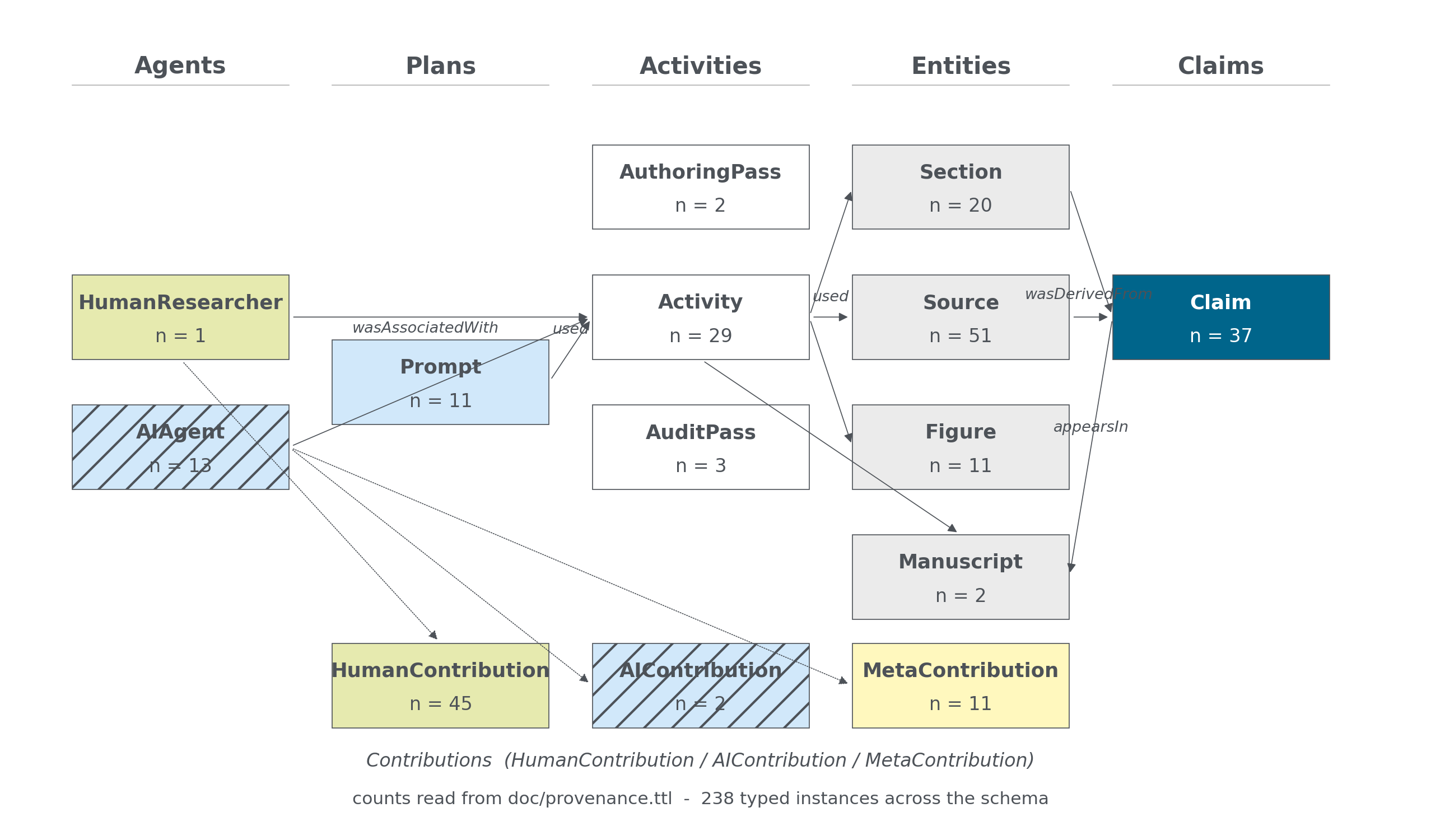
Diagram (Mermaid)
agent:human-author"] M["fair2r:AIAgent
agent:claude-opus-4-7"] SW["Scientific Writer"] SA["Source Analyzer"] FA["FAIR Aligner"] PC["Provenance Curator"] LS["Layout Scrutinizer"] RR["Readability Reviewer"] IL["Illustration"] CO["Condenser"] end subgraph plans["Plans (prompts)"] P_SW["agents/scientific-writer.md"] P_SA["agents/source-analyzer.md"] P_FA["agents/fair-aligner.md"] P_PC["agents/provenance-curator.md"] end subgraph activities["Activities"] A_BOOT["act:bootstrap"] A_AUTH["fair2r:AuthoringPass
act:author-*"] A_FAIR["fair2r:AuditPass
act:audit-fair"] A_LAY["fair2r:AuditPass
act:audit-layout"] A_READ["fair2r:AuditPass
act:audit-readability"] A_CUR["act:curate-provenance"] A_BLD["fair2r:Build
act:build-pdf"] end subgraph entities["Entities"] SRC["fair2r:Source"] MAN["fair2r:Manuscript
paper/main.tex"] SEC["fair2r:Section"] CLM["fair2r:Claim"] PDF["Compiled PDF"] GRAPH["doc/provenance.ttl"] V[("verif:needs-research
verif:ai-confirmed
verif:human-confirmed
verif:source-vendored")] end H -->|"prov:actedOnBehalfOf"| SW H -->|"prov:actedOnBehalfOf"| SA H -->|"prov:actedOnBehalfOf"| FA H -->|"prov:actedOnBehalfOf"| PC SW -->|"hadPlan"| P_SW SA -->|"hadPlan"| P_SA FA -->|"hadPlan"| P_FA PC -->|"hadPlan"| P_PC A_BOOT -->|"prov:wasAssociatedWith"| M A_BOOT -->|"prov:wasAssociatedWith"| H A_BOOT -->|"prov:used"| SRC A_BOOT -->|"prov:generated"| MAN A_AUTH -->|"prov:wasAssociatedWith"| SW A_AUTH -->|"prov:used"| SRC A_AUTH -->|"prov:generated"| SEC A_AUTH -->|"prov:generated"| CLM SEC -->|"prov:hadPrimarySource"| MAN A_FAIR -->|"prov:wasAssociatedWith"| FA A_LAY -->|"prov:wasAssociatedWith"| LS A_READ -->|"prov:wasAssociatedWith"| RR A_FAIR -->|"prov:used"| MAN A_LAY -->|"prov:used"| MAN A_READ -->|"prov:used"| MAN A_CUR -->|"prov:wasAssociatedWith"| PC A_CUR -->|"prov:generated"| GRAPH A_BLD -->|"prov:used"| MAN A_BLD -->|"prov:generated"| PDF PDF -->|"prov:wasDerivedFrom"| MAN CLM -->|"fair2r:verificationState"| V
Reading the graph
Three concentric loops:
-
Authoring loop (left).
Human author → Plan (prompt) → AI Agent → Activity → Section / Claim. Output: prose plus proposed triples. -
Audit loop (right).
AI Agent (FAIR / Layout / Readability) → Activity → Audit report. Output: pass/warn/fail records that gate the next commit. -
Curation loop (bottom).
Provenance Curator → curate-provenance activity → doc/provenance.ttl. The only activity allowed to write the graph itself.
The Build activity is independent of all three: it consumes the
manuscript and emits the PDF, and is reproducible from the repository
alone. That reproducibility is the F(AI)²R closure: the audit AI can
replay the build, walk the graph, and verify that every claim in the
PDF traces back to either a human author or a vendored source.
Worked verification example
The schematic above shows what the graph should look like; this
section shows what it currently does look like, walked by a few
SPARQL queries against the live doc/provenance.ttl. The longer
treatment of the verification programme (SHACL, SPARQL, model
checking, theorem proving) lives in
Provenance verification. The point of
the example below is concrete: a reader of this site, today, can run
the same queries with rdflib (or Apache Jena arq) and reproduce
the numbers without trusting the prose.
Work-in-progress disclaimer. This repository is an actively maintained research artefact; the public topology page reflects the live state of the graph rather than a sanitised after-image. Defects appear, are surfaced by the audit, and are repaired in the open. The previous version of this page advertised 8 defective claims missing
prov:wasGeneratedByedges; this version shows the same conformance query before and after the 2026-05-07 repair pass. Reading the page as a snapshot of work caught and fixed in flight is the intended frame; an audit that never surfaces anything is an audit that has stopped looking.
1. Per-claim provenance trail (a sample)
The shape of a complete claim record is (claim, activity, agent,
rung) — a four-element tuple stating who generated what
through which activity, and at which level of confidence. The
following query returns one row per claim and lets a reader
recompute the rung distribution without re-reading the prose.
PREFIX fair2r: <https://noheton.org/f-ai-r/ns#>
PREFIX prov:   <http://www.w3.org/ns/prov#>
SELECT ?claim ?rung WHERE {
  ?claim a fair2r:Claim ;
         prov:wasGeneratedBy   ?activity ;
         prov:wasAttributedTo  ?agent ;
         fair2r:verificationState ?rung .
} ORDER BY ?rung ?claim LIMIT 8
A representative slice of the result against the graph at the time of this commit:
| Claim | Rung |
|---|---|
ai-rise-motivation |
ai-confirmed |
base-rates-distinct |
ai-confirmed |
practice-disclosure |
ai-confirmed |
cache-bust-versioning |
human-confirmed |
consensus-scholar-default |
human-confirmed |
equity-not-neutral |
human-confirmed |
frontier-model-dependence |
human-confirmed |
consistency-invariant-binding |
source-vendored |
Aggregating across all claims gives the canonical distribution table:
21 human-confirmed, 9 source-vendored, 5 ai-confirmed, 2
needs-research. This is the same distribution that
scripts/provenance_analysis.py writes into the auto-generated
table consumed by paper/sections/provenance-analysis.tex; the
manuscript and the graph agree because they are reading the same
source.
2. Structural defect detection (a SHACL preview)
SELECT queries surface what is present; the more interesting use is
surfacing what is missing. The implicit invariant for a well-formed
claim — at least one prov:wasGeneratedBy, at least one
prov:wasAttributedTo, exactly one fair2r:verificationState — is
not yet enforced in doc/provenance.ttl. A starter SHACL shape would
be:
fair2r:ClaimShape  a sh:NodeShape ;
    sh:targetClass fair2r:Claim ;
    sh:property [ sh:path prov:wasGeneratedBy ; sh:minCount 1 ] ;
    sh:property [ sh:path prov:wasAttributedTo ; sh:minCount 1 ] ;
    sh:property [ sh:path fair2r:verificationState ;
                  sh:minCount 1 ; sh:maxCount 1 ] .
The same invariant, expressed as a SPARQL conformance query, returns the claims a SHACL run would flag:
PREFIX fair2r: <https://noheton.org/f-ai-r/ns#>
PREFIX prov:   <http://www.w3.org/ns/prov#>
SELECT ?claim ?missing WHERE {
  ?claim a fair2r:Claim .
  OPTIONAL { ?claim prov:wasGeneratedBy ?g . }
  OPTIONAL { ?claim prov:wasAttributedTo ?a . }
  OPTIONAL { ?claim fair2r:verificationState ?v . }
  BIND( IF(!BOUND(?g), "wasGeneratedBy",
        IF(!BOUND(?a), "wasAttributedTo",
        IF(!BOUND(?v), "verificationState", "OK"))) AS ?missing)
  FILTER(?missing != "OK")
}
Before the 2026-05-07 repair pass. Run against the graph as
published, the query returned 8 claims missing a
prov:wasGeneratedBy triple — a real, currently-uncorrected
structural defect that the prose had not yet noticed:
| Claim | Missing property |
|---|---|
domain-ontologies-extension |
prov:wasGeneratedBy |
reproducibility-baseline-poor |
prov:wasGeneratedBy |
reviewer-side-ai-policies |
prov:wasGeneratedBy |
bioinformatics-precedent |
prov:wasGeneratedBy |
journal-as-distribution-in-decline |
prov:wasGeneratedBy |
authors-note-voice-exception |
prov:wasGeneratedBy |
formal-methods-cousin |
prov:wasGeneratedBy |
contribution-tracking-rule |
prov:wasGeneratedBy |
After the 2026-05-07 repair pass. The provenance-curator added
the missing edges (and, where no parent activity existed, minted
synthetic act:meta-cooperation-* activities and recorded a
one-sentence reason on each repair). The same query now returns:
| Claim | Missing property |
|---|---|
| (no rows) | — |
Each repair is recorded as a first-class prov:Activity carrying
fair2r:repairs <claim> and an rdfs:comment with the reason the
edge was missing in the first place; the schema gained one new
property (fair2r:repairs, domain prov:Activity, range
fair2r:Claim).
Why those edges were missing
The dominant pattern across the eight defects was the same:
claims that were graduated from a researcher quote into an
existing section, or that rode alongside a meta-decision PR, lacked
a natural act:author-* or act:rev-* parent for the curator to
point at. Five of the eight (reproducibility-baseline-poor,
reviewer-side-ai-policies, journal-as-distribution-in-decline,
formal-methods-cousin, contribution-tracking-rule) needed a
synthetic act:meta-cooperation-<date>-<slug> activity minted at
repair time; the other three (domain-ontologies-extension,
bioinformatics-precedent, authors-note-voice-exception) had a
real activity in the graph but the curator pass had attached it to
the section entity and dropped the symmetric edge on the claim.
The cooperative-process lesson, recorded in
doc/user-observations-log.md, is that
every claim-add step needs to mint or attach to some activity
— even a synthetic meta-cooperation one — and the curator agent
prompt should refuse a claim that arrives with no parent.
A SHACL pass added to CI would fail the build and force the curator
to add the missing edges. That is the first concrete win the
verification programme would buy. The next missing-property class
likely to surface is fair2r:Claim entities lacking a
prov:wasDerivedFrom source for any claim with verif:ai-confirmed
or verif:source-vendored — the analogous chain on the
evidence-trail rather than the activity-trail.
3. Reproducing locally
python3 -c "
from rdflib import Graph
g = Graph(); g.parse('doc/provenance.ttl', format='turtle')
print(len(g), 'triples')
"
Then either paste the queries above into g.query(...) or, for a
heavier session, load the same file into Apache Jena's arq REPL.
The pyshacl runner against the starter shapes is the next step the
verification scoping doc describes.