
F(AI)²R
FAIR research, with AI in the loop — twice. A short-form working paper and a reproducible writing pipeline, versioned together and built under the DLR Corporate Design.
main, and a
copy is vendored at paper/main.pdf
in the repository tree so it's downloadable without CI. Each PDF
carries a DRAFT — not yet peer-reviewed
watermark until publication is explicitly authorised in
paper/publication-consent.md.
Replay locally with make -C paper pdf and compare;
any difference is a defect.
The paper in one screen
FAIR is insufficient for LLM-assisted scholarly writing in its current form; the required extension is multiplicative, not appended; eight integrated practices enforced by a ten-stage agent pipeline are the minimum discipline; this paper is the worked example.
-
The gap. FAIR was drafted for data, then extended to research software and ML models. Neither extension covers what LLM-assisted writing produces — transcripts, prompt files, model + tool manifests, verification-status ladders, per-claim provenance maps. If they vanish, the audit trail is gone.
-
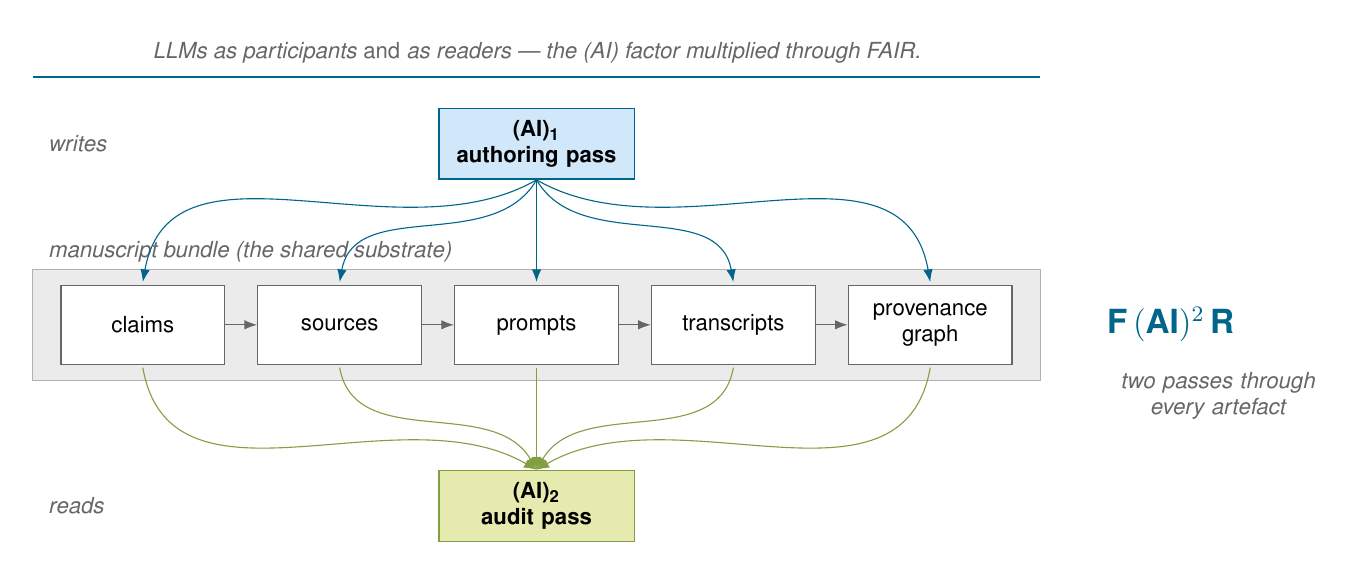
The position. F(AI)²R, read F-A-I-A-I-R: the canonical FAIR axes with an (AI) factor multiplied through them, squared because each axis demands two passes (authoring + audit) and because (AI)² unpacks into a 2×2 of writer × reader.
-
The eight integrated practices. Each individually unoriginal — transcript preservation, verification-status labelling, per-claim provenance maps, mirror discipline, recursive meta-process, base-rate-anchored disclosure, legal honesty about authorship, FAIR-as-precondition. The integration is the contribution. Specialisation reduces hallucination at the seam.
-
The case study. This paper was produced by the pipeline it prescribes. The manuscript, the agent prompts, the provenance graph, the logbook, the slide decks, the conference poster, and the build pipeline are all here.
-
Why now. Some standard with these properties is becoming load-bearing for the next decade of scholarship — the bioinformatics precedent (semantic tagging under data-volume pressure) shows where the trajectory leads. F(AI)²R is one offer.
Walk the artefacts
Slide decks
Two Beamer-rendered slide decks ship as primary artefacts alongside
the manuscript, on the DLR Corporate Design Beamer style
(slides/style/fair2r-beamer.sty, mirroring the paper's
paper/style/fair2r.sty). Same toolchain as the paper PDF
(latexmk + xu-cheng/latex-action); no Marp / Chromium / Node. Both
auto-build on every push to main and live on the
latest-draft-slides release.
What is F(AI)²R?
F(AI)²R re-reads the FAIR principles for an era in which Large
Language Models participate in scholarly production. The (AI)
factor is multiplied through every FAIR axis, squared because each
axis demands two passes over every artefact — an authoring pass
(LLM agents help draft) and an audit pass (a PROV-O graph records
who did what, when, from which sources). Both passes ship
with the manuscript.
The contribution is not the name. It is the integration of eight individually unoriginal practices into a single discipline, enforced by a ten-stage agent pipeline whose prose-owning and audit-owning roles are strictly separated through a handback discipline.
Three things to read first
Methodology
How the paper is actually built: the ten-stage pipeline, the verification ladder as a finite-state machine, the handback discipline.
Read →Provenance graph
The PROV-O graph that travels with the manuscript, rendered as grouped tables and as an interactive node-link diagram.
Browse →Agents
Ten role-specific prompts. Treat them as source code: versioned, diffed, reviewed.
Inspect →All sections
- Methodology — how the paper is actually built.
- FAIR notes — what we add to FAIR, principle by principle.
- Human–AI collaboration — who decides what.
- Agents — the LLM workforce, one prompt per role.
- Logbook — append-only, dated, human-readable.
- Provenance — the PROV-O graph as grouped tables.
- Provenance explorer — the same graph as a click-to-inspect node-link diagram.
- Topology — the same graph as a Mermaid diagram.
- Submission plan — venues and pre-flight checklists.
Imprint
Florian Krebs · ORCID 0000-0001-6033-801X · florian.krebs@dlr.de
DLR Zentrum für Leichtbauproduktionstechnologie (ZLP), Augsburg
Helmholtz-Gemeinschaft · NFDI4Ing · HMC — Helmholtz Metadata Collaboration
Code: MIT. Prose: CC-BY-4.0.